
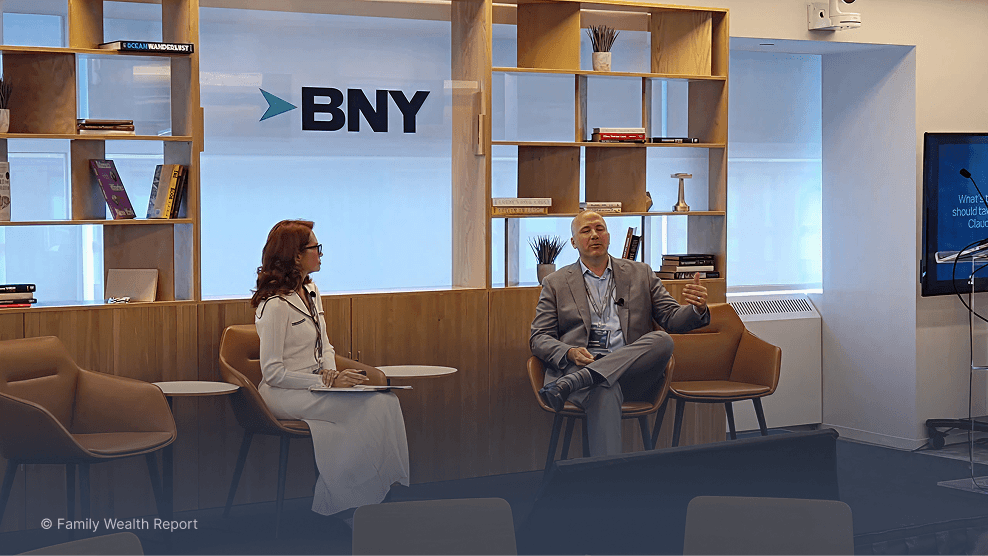
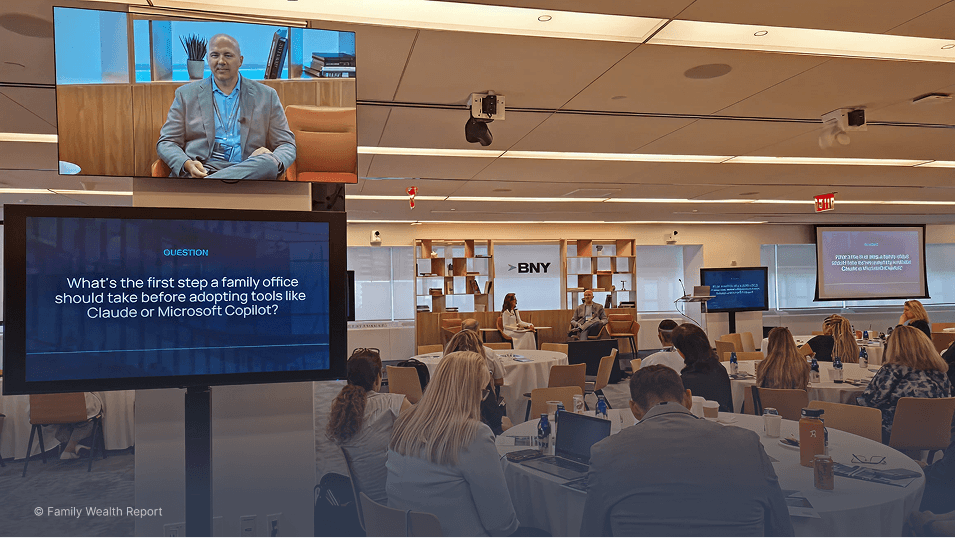
Recently, Farr Shepherd and I had the opportunity to present at the Family Wealth Report Family Office Cybersecurity Forum in New York. The conversations around AI were some of the most practical discussions I’ve heard on the topic because they didn’t all focus on the familiar gloom and doom around AI.
No one in the room was debating whether AI would become part of the family office. Most family offices are already there in some form.
Staff are already using AI to summarize reports, draft communications, organize research, compare vendors, and prepare meeting materials. Investment teams are testing AI-assisted research and operations teams are looking for ways to reduce administrative burden. In some offices, these tools are being introduced formally. In others, they are already being used in the background by staff trying to save time.
The use of AI presents unique risks for family offices. A family office is not a typical business environment. Small teams often manage a wide range of responsibilities across investments, family communications, residences, travel, vendors, advisors, and sensitive personal matters. A tool that feels harmless in a corporate setting can create very different exposure when the data belongs to a principal, a family member, a trust, or a private operating structure.
Family offices can benefit from AI. They just need to adopt it with the same discipline they apply to governance, wealth preservation, and personal security.

Why Family Offices Need an AI Strategy Before Expanding AI Use
One concern came up repeatedly in conversations around the forum: many family offices do not have a complete view of where AI is already being used.
That is not unusual. AI tools are easy to access, inexpensive to test, and often introduced one workflow at a time. A team member may use a public tool for meeting notes. Someone else may ask it to draft an email. Another person may upload a spreadsheet or document to speed up a task without realizing the sensitivity of what they shared.
While none of those decisions may look significant on their own, together they create a governance problem.
Before a family office expands AI use, leadership needs a clear picture of three things: which tools are in use, what data is being entered, and who is responsible for approving future use.

Which tools are in use?

What data is being entered?

Who approves future use?
That is the beginning of a cyber-safe AI adoption strategy.
Where Family Offices Should Begin
The safest starting point is usually the workflow, not the software.
When family offices ask where to begin, I would avoid starting with a tool comparison. Start with the work that consumes time and creates little strategic value. For many offices, practical early use cases include:
Meeting preparation
Document organization
Administrative drafting
Research summaries
Vendor comparisons
Internal knowledge management
These areas can create efficiency without immediately involving the most sensitive family, legal, tax, or investment data. The key is to start where value is clear and risk can be controlled.
That means choosing use cases with defined boundaries, approved tools, and human review before anything is shared, filed, or acted on.
Where AI Use Requires More Caution
Some family office workflows deserve a much higher level of scrutiny. AI should not be casually introduced into processes involving:
Meeting preparation
Estate planning documents
Tax information
Legal communications
Family governance records
Confidential family correspondence
This does not mean that AI can never be used for sensitive work. It can. If you’re going to use it for sensitive work, however, this will require stronger controls.
The family office needs to know where the data goes, whether it is:
Retained
Who can access the output
How a human decision-maker will review the result
This is especially important when AI-generated content could influence decisions, communications, or transactions.
A summary error in a meeting note is one problem. A misleading summary of legal, financial, or governance information is another.
Can Family Offices Use Public AI Tools Safely?
Public AI tools can be useful for low-risk work, but they should not become the default place where staff handle sensitive family office information. In fact, Shepherd strongly recommends that family offices use enterprise tools only.
A simple rule helps:
Anything you would not email broadly, upload to an unknown vendor, or leave in a shared folder should not be entered into a public AI tool without approval.
Family offices should decide what is allowed before staff are left to make judgment calls on their own. That policy needs to be clear.
For example, staff should know whether they can use AI to draft general copy, summarize public research, or brainstorm general travel logistics. They should also know what is off limits, such as trust documents, financial statements, passport information, security details, private family communications, and wire instructions.
The AI Governance Questions Family Offices Should Answer
One of the most useful exercises is also one of the simplest: write down the questions your family office would need to answer if a principal, auditor, insurer, or advisor asked how AI is being managed.
Start here:
01
Who is allowed to approve AI tools?
02
Which tools are approved today?
03
Are staff using personal AI accounts for family office work?
04
What types of data are prohibited from being entered?
05
Are prompts and outputs retained by the vendor?
06
How are AI-generated outputs reviewed before use?
07
Who is responsible for vendor due diligence?
08
What happens if sensitive information is entered into an unapproved tool?
Why AI Governance Belongs With Family Office Cybersecurity

AI governance should not sit in isolation.
It belongs alongside cybersecurity, privacy, vendor risk, and incident response because the same controls often determine whether AI adoption is safe.
Identity management
matters because access to AI tools should be controlled
Vendor risk
matters because AI platforms may store, process, or learn from submitted data
Security awareness
matters because staff need to recognize when a request, summary, or message may be manipulated
Incident response
matters because AI platforms may store, process, or learn from submitted data
This is why family office cybersecurity and AI strategy are now closely connected.
A family office with strong access controls, documented data flows, vendor review processes, and clear escalation paths will have an easier time adopting AI safely. An office without those foundations may find that AI exposes governance gaps that already existed.
Is your family office thinking about deploying custom AI? We’ve created an AI Consultant Vetting Checklist — questions to ask before you hand your data architecture to anyone outside your organization.
AI Risk Extends Beyond the Family Office
For family offices, AI risk does not stop at the office network.
AI can be used to make phishing emails more convincing, clone voices, impersonate advisors, generate fake documents, and personalize social engineering attempts using information collected from public sources, data brokers, or prior breaches.
This is especially important in the context of family offices because they operate through trust. For example, a principal recognizes a voice, a staff member recognizes a writing style, and an advisor relationship has existed for years. AI makes those familiar signals easier to imitate.
A cyber-safe AI roadmap should account for the full family ecosystem, not just the office. That includes:
Residences
Staff
Advisors
Travel
- Aviation
Marine assets
Household Technology
Personal devices family members use every day
This is where Decypher’s family office work is different from a traditional office-only cybersecurity model. We look at the family office and the private environments around the family as connected domains of risk. AI adoption should be evaluated the same way.
What a Cyber-Safe AI Roadmap Should Include
A practical AI roadmap for a family office should give leadership enough structure to make sound decisions and enough flexibility to adopt useful tools.
At a minimum, the roadmap should include:
01
Inventory of AI tools already in use
Start by identifying what staff are using today, including personal accounts used for office-related work.
02
Data classification policy
Define what information is public, internal, confidential, or highly restricted, and map those categories to approved AI use.
03
Approved use cases
Document where AI may be used safely, where approval is required, and where use is prohibited.
04
Vendor review
Evaluate AI vendors for data retention, access controls, security practices, contractual terms, and privacy protections.
05
Human review requirements
Define when AI-generated outputs must be reviewed before being used in communications, reports, decisions, or workflows.
06
Training for staff and trusted advisors
Make sure everyone understands the policy in plain language, including assistants, household staff, advisors, and anyone who handles sensitive information.
07
Incident response procedures
Decide what happens if sensitive information is entered into an unapproved AI tool or if AI-enabled impersonation is suspected.
At Decypher, we’ve created an AI Deployment Readiness Checklist that walks you through the steps. Click here to download the checklist.
A Better Way to Think About AI Adoption
What stood out to me during the forum was how practical the conversation became once people moved past the excitement around AI itself.
Family office executives were asking grounded questions. Where can AI save time? Where could it create exposure? Who should approve tools? How do we keep family information protected? What does responsible use look like when the office is small and the data is highly sensitive?
Those are the right questions.
AI will continue to move into family office operations. The offices that benefit most will be the ones that understand where AI can help, where human judgment needs to stay firmly in place, and what controls are necessary before adoption spreads.
How Decypher Helps Family Offices Build Cyber-Safe AI Strategies
At Decypher, we help family offices evaluate AI adoption through the same lens we use for cybersecurity:

People

Systems

Vendors

Residences

Private environments
That work may include reviewing current AI use, mapping sensitive data flows, assessing vendor risk, strengthening identity and access controls, training staff, and building practical governance policies that can actually be followed.
A cyber-safe AI strategy should give the family office a clear way to use AI where it helps and pause where the risk is not yet understood.
If your family office is evaluating AI initiatives and wants to protect privacy, governance, and family assets in the process, Decypher can help.
Further Reading


Annette Garcia-Acosta is Director of Communications at Decypher Technologies, where she leads content strategy and brand communications across the company’s cybersecurity and managed IT practices. Her work centers on making complex technical subjects clear and accessible for non-technical decision-makers, including the family offices and ultra-high-net-worth clients Decypher serves.
Before specializing in technology communications, Annette developed curriculum and exhibition materials for internationally recognized institutions, including the Ghetto Fighters’ House Museum in Israel and the Memorial and Museum Auschwitz-Birkenau. Her background spans technology communications, educational content development, and historical research.